Commercial Car Vacuum Cleaner Maintenance Guide

mmwblog
Published on November 10, 2026 • 14 min read
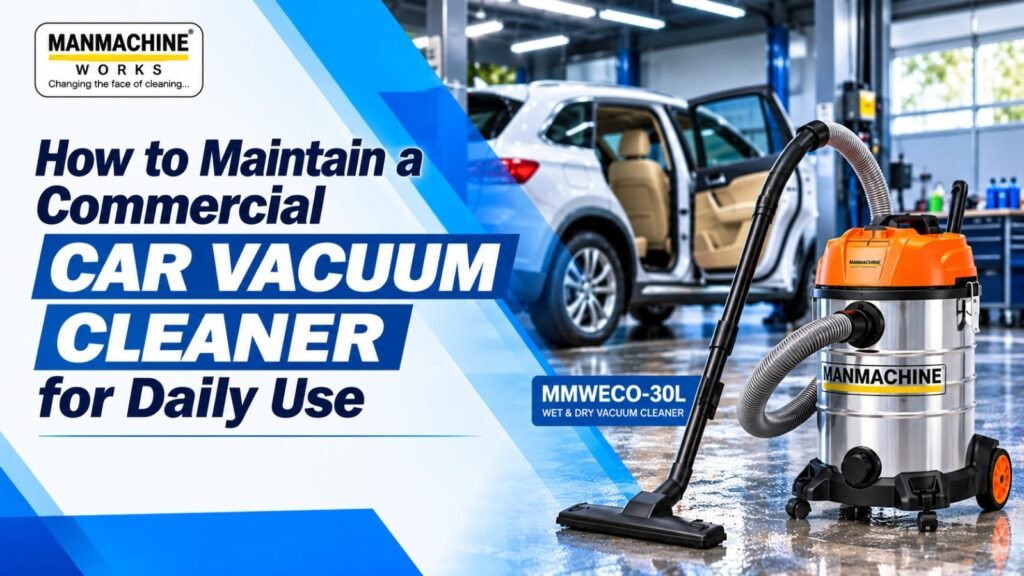
How to Maintain a Commercial Car Vacuum Cleaner for Daily Use
Think about what a single car brings into your bay. Sand in the floor carpets, crumbs under the seats, a few small stones from the boot, and a fine layer of dust on everything else.
Now multiply that by a full day of customers.
A commercial car vacuum cleaner takes all of that, shift after shift. Somewhere around the third week, the filter is packed with dust, the hose has a receipt wedged in it, and the tank is fuller than anyone noticed.
The machine still runs. It just stops pulling properly, and interior cleaning slows down.
Most of this is avoidable. A few minutes of checking at the start and end of each shift keeps suction steady and catches small faults early.
This guide covers how to maintain a car vacuum cleaner machine in a working car wash or detailing studio: what to check daily, how to look after filters, what to do when suction drops, and when to stop and call a technician.
Before we start, here is a quick answer to the question – How to maintain a commercial car vacuum cleaner
To maintain a commercial car vacuum cleaner, empty the collection tank before it fills, inspect the filter, check the hose for blockages and clean the attachments after use.
Keep the motor vents clear and store the machine somewhere dry.
On wet and dry models, use the correct filter setup for each mode. Follow the manufacturer’s manual, and leave electrical faults to qualified service personnel.
Why Commercial Car Vacuum Cleaner Maintenance Matters
A household vacuum might run twenty minutes a week.
A professional car vacuum cleaner can run for hours, and it works on dashboards, seat gaps, carpets and boot corners in the same session.
The filter, hose, tank and motor all carry that load.
Looked after, the machine gives you:
- Steady suction through the whole shift
- Fewer blockages
- Filters that do their job
- No sour smell from a neglected tank
- Damaged parts spotted before they fail
- Fewer interruptions in the middle of a busy day
Maintenance won’t make a motor immortal. Parts wear out, and that’s normal. But a car wash that loses its only vacuum for two days has a real scheduling problem, so catching trouble early is worth the effort.
Know the Main Parts of Commercial Car Vacuum Cleaner
Before you maintain a machine, it helps to know what you’re looking at. Most commercial units have a motor, a collection tank, a filter, a suction hose, attachments and a power cable.
| Part | What it does | What to check |
| Motor unit | Creates suction | Unusual noise, overheating |
| Filter | Traps dust and debris | Clogging, tears |
| Collection tank | Holds waste | Empty and clean regularly |
| Suction hose | Carries dirt to the tank | Blockages, cracks |
| Nozzles and brushes | Clean different surfaces | Trapped hair and dirt |
| Power cable | Supplies electricity | Visible damage |
| Wheels and handles | Move the machine | Free movement, condition |
| Seals and connections | Keep airflow intact | Loose or damaged fittings |
Designs differ by model. Some machines use cloth filters, others use cartridges. Keep the manual close to the machine.
Daily Maintenance Checklist for Commercial Car Vacuum Cleaner
Do these checks before and after each shift. Before touching anything, switch the machine off, unplug it and follow the manufacturer’s safety instructions.
1. Check the collection tank
A tank that is too full chokes airflow. Empty it before it reaches the maximum level marked by the manufacturer, not after the machine starts leaving dirt behind.
After emptying dry waste, look inside for leftover dust. If the machine has picked up liquid, drain and clean it as the manual describes. A damp, dirty tank smells within a day or two.
2. Inspect the filter
The filter stops fine dust before it reaches the motor. As dust builds up on it, airflow drops and suction weakens, even when the tank is nearly empty.
Clean or replace it only by the approved method. Not every filter can be washed. If yours can, make sure it is completely dry before it goes back in.
And never run the machine without a required filter.
3. Check the suction hose
A blocked hose is one of the most common reasons for weak suction. Car interiors give it plenty to choke on: hair, paper, leaves, bits of plastic.
Look for cracks, loose connections and obvious blockages. If you suspect one, switch off and unplug first, then clear it the way the manual says.
Don’t push sharp tools through the hose, because a puncture lets air escape and the suction problem gets worse.
4. Clean the attachments
A crevice nozzle gets into seat gaps. A floor tool handles carpets and mats. Hair and threads wrap around both.
Knock off loose debris after use, clean them as recommended, and replace anything cracked.
5. Look at the power cable
Check for worn insulation, a damaged plug or loose connections before each shift. Don’t use a machine with a damaged cable.
Have qualified personnel inspect or replace it. And don’t drag the machine by the cable or let vehicles roll over it.
How to Clean a Commercial Vacuum Cleaner Filter
Vacuum cleaner filter cleaning matters more than most operators expect. A blocked filter reduces airflow even when the tank is empty. The right method depends on the filter type.
- Cloth filters: Check whether the manufacturer allows shaking, brushing or washing. If washing is allowed, follow the drying instructions exactly. Don’t refit a damp filter unless the manual specifically calls for it in a particular mode.
- Cartridge filters: Common in wet and dry machines. Some are for dry use only, others are approved for certain wet jobs. Look for dust buildup and tears, and don’t wash one unless the manufacturer says it’s washable. Replace damaged cartridges with compatible parts.
- Fit matters too: A clean filter that is seated loosely still lets dust through and disturbs airflow. Before you switch on, confirm it is fitted securely.
Manmachine Works lists cartridge-filter maintenance for the MMWECO-30L Wet and Dry Vacuum Cleaner.
The product information recommends cleaning the filter periodically and checking that the right filter and accessories are in place when you switch between wet and dry cleaning.
Whatever machine you own, go by the instructions supplied with it.
How to Maintain a Wet and Dry Vacuum Cleaner
A wet and dry vacuum cleaner can pick up dry dirt and certain liquids when it is set up correctly. That makes it handy in car wash centres and workshops, but it also adds a few steps.
- Confirm the mode before you start: Check that the machine is approved for wet use and configured the way the manual requires. Some dry filters must be removed or swapped for wet collection. Don’t assume one setup suits both.
- Empty liquid properly: Don’t leave dirty water sitting in the tank overnight. Drain it following the manufacturer’s instructions and local disposal rules, then check for leftover dirt.
- Clean and dry the tank: After wet use, wash the tank by the approved method and let it dry fully before storage. That cuts down odour and residue.
- Check the shut-off: If the machine has a float or liquid shut-off, inspect it as the manual directs. Never bypass or modify it.
- Store it dry: Keep the machine in a protected spot, and keep hoses and cables out of wet areas.
The MMWECO-75L Wet and Dry Vacuum Cleaner from Manmachine Works has a 75-litre collection tank and a drainage provision. Its product information lists filter cleaning, tank drainage and dry storage among the maintenance recommendations.
Common Suction Problems and Their Causes
When suction drops, the machine usually still runs. It just takes three passes over a carpet where one used to do. Before you blame the motor, go through the simple causes first.
| Problem | Likely cause | What to do |
| Weak suction | Full tank | Empty the tank |
| Weak suction | Blocked filter | Inspect and clean or replace |
| Reduced airflow | Hose blockage | Check the hose safely |
| Poor pickup at the nozzle | Debris in the attachment | Clean the attachment |
| Air escaping | Damaged hose or loose connection | Check and replace faulty parts |
| Machine cuts out | Overheating or electrical fault | Switch off and arrange service |
| Unusual smell | Dirty tank or component fault | Stop and inspect per the manual |
| Strange motor noise | Mechanical problem | Stop and request service |
If you see smoke or sparks, or smell burning, stop. Disconnect the machine from power when it is safe to do so and have qualified personnel look at it.
Why does a commercial vacuum cleaner lose suction?
Suction depends on air moving freely through the machine. Anything that restricts the hose, filter or tank cuts that flow, and less dirt gets lifted.
In a busy detailing studio you notice it first on floor carpets, where operators start going over the same patch again and again.
Running the machine longer isn’t the fix.
Check the tank, the filter and the hose, in that order.
If all three are fine and suction is still poor, stop using the machine and call the service team. The motor or an internal seal may need a professional inspection.
Preventing Vacuum Cleaner Motor Overheating
Motors make heat. Commercial machines are built to handle it within their rated conditions, but trouble starts when airflow is restricted or the machine is worked beyond its duty cycle.
Common causes of overheating:
- Blocked filters
- Restricted airflow
- Covered or obstructed ventilation openings
- Wrong machine configuration
- Electrical supply problems
- Running beyond the permitted duty cycle
- Internal mechanical or electrical faults
Keep visible vents clear. Don’t throw a towel or plastic sheet over the motor unit while it runs.
If the machine overheats or shuts down on its own, stop, let it cool only as the manufacturer instructs, and find the cause before using it again.
And don’t open the motor housing unless you are trained and authorised to do so.
Weekly Maintenance of Commercial Vacuum Cleaner
Daily checks keep the machine ready for the next job. A weekly look goes deeper at the parts that wear.
- Check filter condition
- Look for cracks or deformation in the hose
- Examine all nozzles and brushes
- Inspect tank seals and connections
- Make sure wheels and handles move freely
- Examine the power cable
- Note any unusual sounds or suction complaints
- Wipe down the exterior
- Flag parts that need replacing
Treat this as a starting point, not a replacement for the manufacturer’s service intervals. A workshop with heavy daily use may need to check more often than a small studio.
Monthly Maintenance Commercial Vacuum Cleaner
Once a month, step back and look at the machine’s overall condition. Read through the maintenance record.
Ask staff whether they’ve had weak suction, repeated blockages, broken accessories or sudden shutdowns.
Inspect accessible parts as the manual describes, and make sure you have spare filters and common accessories on hand.
If a service is due, book an authorised technician. Don’t dismantle the motor, internal wiring or protective systems as routine operator maintenance.
Daily, Weekly and Monthly Schedule
| Task | Daily | Weekly | Monthly |
| Check and empty tank | Yes | — | — |
| Inspect hose for blockage | Yes | Detailed check | — |
| Check filter condition | Yes | Detailed check | As required |
| Clean attachments | Yes | Inspect wear | — |
| Check power cable | Yes | Detailed check | — |
| Inspect wheels and handles | — | Yes | — |
| Review seals and connections | — | Yes | As required |
| Review performance complaints | — | Yes | Yes |
| Review maintenance records | — | — | Yes |
| Arrange professional service | As needed | As needed | Per manual |
Looking After Accessories
The narrow tools reach seat rails, door pockets and boot corners.
The wide floor tools handle carpets and mats. When either gets clogged or cracked, cleaning slows down and the machine works harder than it should.
Pull out trapped hair and threads, and don’t use a damaged tool on delicate interior surfaces. Keep accessories in a clean, organised spot where no vehicle will roll over them, and replace worn ones with compatible parts.
Mistakes That Shorten a Vacuum’s Life
- Ignoring a full tank: It chokes airflow and wears the machine. Empty it as the manufacturer recommends.
- Using the wrong filter: Wet and dry jobs can need different arrangements. The wrong one can damage the machine or make it unsafe.
- Running with a blocked hose: Stop and clear it. Pushing on with weak suction strains the motor.
- Pulling the machine by its cable: The cable isn’t a handle. Use the handles and wheels.
- Vacuuming unsuitable material: Hot ash, flammable liquids and hazardous dust don’t belong in an ordinary commercial car vacuum cleaner. They need special equipment and trained handling.
- Ignoring odd noises: A new vibration, a grinding sound or a burning smell is not normal. Stop and get it inspected.
- Storing it dirty or wet: Empty and clean the machine, then put it away in a protected area.
Organising Maintenance in a Car Wash Centre
When five people share one vacuum, each assumes someone else emptied the tank.
Give the job to one trained operator at the start of each shift, and at the end of the day have someone record whether the machine is clean, stored properly and ready.
A basic record is enough:
- Machine name or ID
- Inspection date
- Operator name
- Tank condition
- Filter condition
- Hose and attachment condition
- Problems reported
- Service action needed
It pays off quickly. If the same machine loses suction every week, the log will usually show whether the cause is a filter, a hose or the way it’s being used.
Choosing a Machine That’s Easy to Maintain
Maintenance should also shape what you buy. Ask how easily staff can inspect, empty, clean and store the machine.
- Tank capacity: Match it to your cleaning volume. A bigger tank means fewer stops to empty it, but it has to fit your space.
- Filter access: You should be able to inspect and replace the filter without a complicated procedure.
- Spare parts: Make sure compatible hoses and accessories are easy to get.
- Wet and dry needs: If you collect liquid, buy a machine designed for it.
- Service support: Ask about maintenance guidance, warranty terms and replacement parts.
- Movement and storage: Think about how easily it moves between cars and where it lives at night.
Manmachine Works offers a range of commercial car vacuum cleaner machines, including wet and dry models for professional work. For help choosing, read our guide to Car Vacuum Cleaners for Workshops and Detailing Studios.
Maintenance for Indian Car Wash Centres
Conditions vary a lot across India. A studio in Delhi or Noida deals with steady dust and road grime. A coastal or humid location needs more care when storing equipment.
In the monsoon, wet mats and muddy interiors add to the workload.
In dusty conditions, check filters more often than the manual’s minimum. In wet weather, never leave collected water in a wet and dry vacuum after you finish.
Use electrical equipment only where it is suitable to operate, keep cables and connections away from standing water and moving vehicles, and follow local electrical safety rules along with the manufacturer’s instructions.
Base your schedule on how hard the machine actually works, not just the calendar.
When a Vacuum Cleaner Isn’t Enough
A vacuum removes loose dirt and dust. It doesn’t treat a spilled drink or a food stain that has soaked into a fabric seat.
For that, detailing studios use a dedicated upholstery extraction machine.
Manmachine Works has a range of car upholstery cleaner machines for compatible fabric cleaning. Using the right machine for each job also saves the vacuum from unnecessary strain.
Final Thoughts
A commercial car vacuum cleaner earns its place in a car wash centre, detailing studio or workshop by running every day. Keeping it in shape doesn’t take much.
Empty the tank, check the filter, look at the hose and clean the attachments.
Set it up correctly for wet or dry work, and store it somewhere protected.
Follow the manufacturer’s schedule, and leave electrical and internal repairs to qualified technicians.
A few minutes of checking each shift is usually all it takes to find a problem before it stops the working day.
Explore Commercial Car Vacuum Cleaners at Manmachine Works
Manmachine Works supplies professional car wash and detailing equipment to automotive businesses across India.
Our vacuum cleaner range covers car wash centres, detailing studios and workshops, from compact machines for daily interior cleaning to larger wet and dry models.
Compare specifications, explore the range and contact our team for product selection and service information.
Frequently Asked Questions
How often should a commercial car vacuum cleaner be maintained?
Give it basic checks before and after each shift. Filter cleaning, detailed inspections and servicing should follow the manufacturer’s instructions and your working conditions.
Why does my car vacuum cleaner lose suction?
Usually a full tank, a blocked filter, a clogged hose, a loose connection or a damaged part. Check the accessible parts safely, and call for service if the problem continues.
Can I wash a commercial vacuum cleaner filter?
Only if the manufacturer says it is washable. Some filters need dry cleaning or replacement. A washable filter must be dried as instructed before it goes back in.
How do I prevent vacuum cleaner motor overheating?
Keep airflow paths clear, maintain the filters, clear hose blockages and stay within the machine’s duty cycle. If it overheats or behaves oddly, stop using it.
Can a wet and dry vacuum cleaner be used without a filter?
No. Don’t run it without a required filter or protective part. Wet and dry modes can need different setups, so follow your machine’s manual.
What should I do if the vacuum makes an unusual noise?
Switch off and disconnect it safely. Check only the accessible parts the manual allows. If the noise continues or seems to come from the motor, contact qualified service personnel.
What is the difference between a commercial and an industrial vacuum cleaner?
The terms overlap. Industrial vacuum cleaners may be built for heavy-duty environments or particular materials. The right choice depends on specifications, filtration, duty cycle and approved applications.
When should a commercial vacuum cleaner be replaced?
When a qualified technician confirms it is no longer safe or practical to repair, when parts are no longer available, or when it no longer meets your needs.