Car Wash Water Recycling System: Equipment and Guide

mmwblog
Published on October 28, 2026 • 12 min read
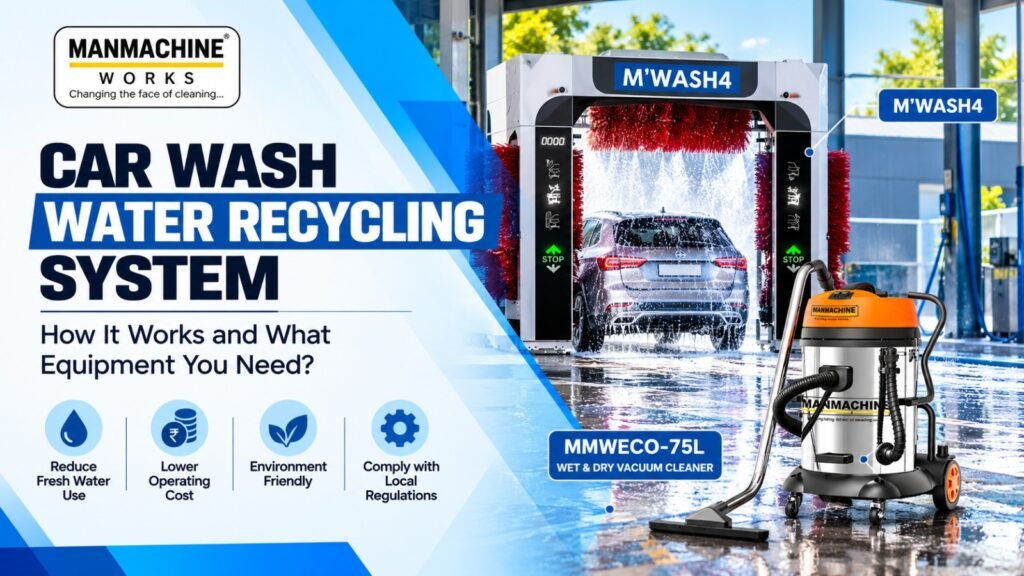
Car Wash Water Recycling System: How It Works and What Equipment You Need
A car wash centre uses water throughout the day. From removing mud to rinsing shampoo, every wash adds to the business’s water requirement.
For a busy centre, this can become a significant operating expense. Water availability may also be a concern, particularly in locations that depend on tankers or have an unreliable supply.
A car wash water recycling system helps reduce fresh water consumption by collecting used wash water, treating it and making it available for suitable washing tasks.
But not every system works in the same way. The equipment you need depends on how many cars you wash, the type of cleaning chemicals used and the quality of water required by your machines.
This guide explains how car wash water recycling works, which equipment may be needed and what to consider before installing a system in India.
What Is a Car Wash Water Recycling System?
A car wash water recycling system is a treatment arrangement that collects used vehicle washing water, removes contaminants and stores the treated water for approved reuse.
The process may involve settling tanks, oil separation, filtration, disinfection and pumps.
The exact treatment stages depend on the wastewater and the intended use of the treated water.
For example, water reused for an initial vehicle wash may have different quality requirements from water used for the final rinse.
A recycling system does not automatically make wastewater suitable for every purpose. The treated water must meet the requirements of the washing equipment, cleaning process and applicable regulations.
Why Do Car Wash Businesses Consider Water Recycling?
There are several reasons a car wash business may consider recycling wash water.
Lower Fresh Water Requirement
Reusing suitable treated water can reduce the amount of fresh water purchased or drawn for daily washing.
The actual reduction depends on the recycling system, washing process and water losses.
Better Water Management
A centre with a limited or unreliable water supply may benefit from having a planned water collection and reuse arrangement.
However, recycling does not eliminate the need for fresh water.
Wastewater Management
Vehicle washing produces wastewater containing dirt, cleaning products and other contaminants.
A suitable treatment system can help manage this wastewater, but recycling alone does not guarantee compliance with discharge requirements.
Planning for Business Growth
If a centre adds washing bays or an automatic machine, its water demand may increase.
Considering recycling during the initial layout stage can make it easier to plan tanks, drains and treatment equipment.
How Does a Car Wash Water Recycling System Work?
A typical car wash water recycling system uses several treatment stages.
Not every installation needs the same equipment, and the treatment process should be selected after assessing the wastewater.
Step 1: Collect Used Wash Water
Water from the washing bay flows towards collection drains.
These drains carry used water to a collection chamber or tank.
The floor layout should allow water to reach the collection points without spreading into other working areas.
For a new facility, plan drainage alongside the car wash equipment layout.
Step 2: Remove Sand and Heavy Dirt
Vehicle washing water often contains mud, sand and road dust.
A grit trap or settling chamber allows heavier particles to separate from the water.
Removing these materials early helps reduce the load on later treatment stages.
Step 3: Separate Oil and Grease
Depending on the vehicles and cleaning work, wastewater may contain oil and grease.
An oil-water separator can help remove free oil from the water.
However, emulsified oil may require additional treatment.
The separator should be selected according to the actual wastewater characteristics.
Step 4: Treat Fine Suspended Contaminants
Some systems use settling and chemical treatment to remove finer particles.
The treatment method depends on the wastewater quality.
Chemical dosing, where required, should be designed and managed by qualified treatment professionals.
Step 5: Filter the Water
Filtration helps remove remaining suspended particles.
A treatment system may use suitable media filters or other filtration technologies.
Activated carbon or additional treatment stages may be used where the water quality assessment identifies a need.
A filter does not remove every dissolved contaminant.
Step 6: Disinfection, When Required
Stored recycled water may develop microbial growth or unpleasant odours.
Some systems include a disinfection stage.
The need for disinfection and the selected technology depend on the intended reuse and water quality requirements.
Step 7: Store and Reuse Treated Water
After treatment, water is stored in a designated tank.
A suitable pump supplies it to approved washing applications.
The treated water should be monitored to ensure that its quality remains appropriate for reuse.
What Equipment Is Needed for Car Wash Water Recycling?
The equipment required depends on the treatment design.
| Equipment | Main Purpose |
| Collection drains | Collect used washing water |
| Grit trap | Separate sand and heavier particles |
| Collection or settling tank | Hold wastewater before treatment |
| Oil-water separator | Remove suitable free oil and grease |
| Treatment system | Address contaminants identified during testing |
| Filtration unit | Remove specified suspended material |
| Disinfection unit | Control microbial contamination where needed |
| Transfer pumps | Move water between treatment stages |
| Treated water tank | Store water for approved reuse |
| Monitoring and controls | Help manage operation and identify faults |
| Sludge handling arrangement | Manage separated solids and treatment waste |
This is a general equipment list rather than a fixed specification for every car wash centre.
A professional supplier should assess the wastewater, expected flow and required reuse quality before recommending a treatment system.
How Much Water Does a Car Wash Use?
Water consumption depends on the washing method, machine flow rate, operator practices and vehicle condition.
A manual pressure washer does not necessarily use the same amount of water as an automatic washing system.
For pressure washers, you can estimate water delivery using:
Water delivered = Machine flow rate × Actual spraying time
For example, consider a machine rated at 10 litres per minute.
If the operator sprays continuously for five minutes, the calculated water delivery is:
10 × 5 = 50 litres
If the operator releases the trigger between washing stages, actual water delivery will differ.
This calculation also does not include water used by other equipment or processes.
When choosing a commercial car washer, check the rated flow rate and expected operating pattern.
These details will help you estimate the water demand of your washing bay.
How to Calculate Water Recycling System Capacity
Before selecting a recycling system, estimate how much water your business uses.
Start with the number of vehicles washed daily.
Then estimate the water used for each service.
Example: A Car Wash Centre Washing 40 Cars Daily
Suppose a centre washes 40 cars per day.
For planning purposes, assume each wash uses 150 litres.
| Calculation | Result |
| Vehicles per day | 40 |
| Assumed water use per vehicle | 150 litres |
| Total daily water use | 6,000 litres |
| Illustrative recovery assumption | 70% |
| Potential recovered volume | 4,200 litres |
These are example assumptions, not measured results or guaranteed savings.
A 70% recovery assumption does not mean the business will automatically reduce its fresh water purchases by exactly 70%.
Actual results depend on collection losses, treatment losses, reuse restrictions, water quality and operating conditions.
Consider Peak Hour Demand
Daily water consumption is only part of the calculation.
A centre may wash several vehicles during its busiest hour.
The treatment system and storage tanks should be designed for the actual flow pattern.
For example, two washing bays operating simultaneously may create a higher short-term water demand than one bay operating throughout the day.
Allow for Future Expansion
If you plan to add another washing bay, discuss expansion requirements before construction.
Tank placement, drainage and treatment capacity may need additional provisions.
Water Recycling for Manual Car Wash Bays
Many Indian car wash centres use manually operated pressure washers.
These businesses may have one or more washing bays with operators controlling the washing guns.
Water recycling can be considered for these setups, but the design should match their operating conditions.
Important considerations include:
- Number of active washing bays
- Water flow rate of each washer
- Actual spraying time
- Type of cleaning products used
- Available floor space
- Drainage arrangement
- Water quality required for reuse
A small facility does not automatically need the same treatment equipment as a large commercial wash.
Likewise, a compact system may be unsuitable if the wastewater contains contaminants it cannot adequately treat.
When planning a new centre, review the available car wash machines and discuss their water requirements with your equipment supplier.
Water Recycling for Automatic Car Wash Systems
Automatic car wash systems can have different water-use patterns from manual washing bays.
Some systems deliver water at several stages of a programmed washing cycle.
This can create periods of higher demand.
When planning recycling for an automatic facility, consider:
- Water used during each washing stage
- Number of cycles per hour
- Peak water delivery requirements
- Collection tank capacity
- Treatment system throughput
- Treated water storage
- Water quality requirements of the machine
Do not assume that every automatic washing system can use recycled water at every stage.
The manufacturer may specify different water quality requirements for different parts of the cycle.
Explore the automatic car wash machine range and obtain model-specific water and installation specifications before selecting the recycling equipment.
Can Recycled Water Be Used for the Final Rinse?
It depends on the quality of the treated water and the requirements of the washing process.
Water that has been filtered may still contain dissolved minerals and other substances.
These can contribute to spotting or deposits after drying.
For this reason, many washing processes use appropriately treated fresh water or higher-quality water for the final rinse.
Recycled water may be suitable for other washing stages if it meets the relevant quality requirements.
Do not assume that visibly clear water is safe for every washing task.
If your business offers ceramic coating preparation or premium detailing, confirm the water quality needed for the final cleaning and rinsing process.
What Should Indian Car Wash Owners Check Before Installation?
Water recycling systems must be planned according to the business location and applicable rules.
Requirements can differ between states, municipalities and types of facilities.
Wastewater Discharge Rules
Check whether your proposed activity requires pollution control consent or other permissions.
Also confirm the conditions for wastewater collection, treatment, reuse and discharge.
Site Drainage
The washing area should direct used water towards the intended collection system.
Avoid arrangements that allow untreated wastewater to flow outside the designated area.
Water Source
Consider whether your business uses municipal supply, borewell water or tankers.
Water quality can affect both washing equipment and treatment requirements.
Available Space
Treatment tanks, pumps and filtration equipment require installation and maintenance access.
Discuss the layout before completing civil work.
Qualified System Design
Wastewater treatment should be designed according to the actual wastewater characteristics and applicable standards.
A system suitable for one car wash centre may not be suitable for another.
Does a Water Recycling System Reduce Car Wash Operating Costs?
It can reduce fresh water requirements, but the financial benefit depends on the full operating cost.
Before investing, compare the expected savings with the costs of operating and maintaining the treatment system.
Consider:
- Initial equipment and installation cost
- Water purchase or supply cost
- Electricity consumption
- Filter and treatment media replacement
- Sludge handling and disposal
- Testing and monitoring
- Maintenance and professional servicing
- Water quality requirements
Example of a Simple Savings Calculation
Suppose a business reduces fresh water purchases by 3,000 litres per day.
That equals 3 kilolitres.
If the effective purchased-water cost is ₹100 per kilolitre, the gross avoided water purchase would be:
3 × ₹100 = ₹300 per day
This is only an illustrative calculation.
It excludes the cost of treatment, electricity, maintenance, testing and other operating expenses.
Actual water tariffs and tanker costs vary by location.
A payback period should be calculated using a supplier quotation and realistic operating data, not a general industry estimate.
Common Car Wash Water Recycling Mistakes
Choosing a System Without Testing Wastewater
Different washing processes produce different wastewater.
A system should be selected according to the contaminants it needs to remove.
Ignoring Peak Water Flow
A system sized only for daily consumption may struggle during busy periods.
Assuming Every Filter Removes Every Contaminant
Filtration, oil separation and other treatment stages have different purposes.
Using Treated Water Without Checking Quality
Clear-looking water does not automatically meet the requirements for reuse.
Forgetting Sludge Disposal
Treatment systems generate separated waste that needs appropriate handling.
Ignoring Maintenance Requirements
Tanks, pumps, filters and monitoring equipment require regular inspection.
Assuming Recycling Guarantees Legal Compliance
A recycling system must still meet applicable consent, treatment and discharge conditions.
Car Wash Water Recycling System Maintenance Checklist
Routine maintenance helps identify changes in water quality and equipment operation.
| Frequency | Recommended Activity |
| Before operation | Check visible leaks, warning indicators and accessible collection areas |
| Routine inspection | Review pump operation and tank conditions according to the manual |
| Scheduled inspection | Check filters, treatment media and monitoring records |
| As required | Arrange sludge removal and approved waste disposal |
| Manufacturer schedule | Service pumps, controls and treatment components |
| Compliance schedule | Complete required water testing and documentation |
The correct frequency depends on the installed system, operating conditions and supplier instructions.
Do not use a generic timetable as a replacement for the manufacturer’s maintenance plan.
For other machines at your facility, read the car wash equipment maintenance checklist.
Questions to Ask Before Buying a Water Recycling System
Before requesting a quotation, ask the supplier:
- What wastewater testing is required?
- What treatment stages are recommended for this site?
- What is the system’s rated treatment capacity?
- How will it handle peak washing demand?
- What water quality can it achieve?
- Which washing stages can use the treated water?
- What fresh water top-up will still be required?
- What are the maintenance and operating costs?
- How will sludge and other treatment waste be handled?
- What testing and compliance documentation will be needed?
Ask for the treatment process, performance assumptions and maintenance requirements in writing.
Planning a New Car Wash Centre With Manmachine Works
If you are setting up a new car wash centre, it is useful to plan the washing equipment and water management arrangements together.
The number and type of machines affect the water demand of the facility.
Manmachine Works offers professional car washing equipment for different business applications.
You can explore:
Use the selected machine specifications to discuss water supply, drainage and recycling requirements with a qualified treatment-system provider.
FAQs
1. What is a car wash water recycling system?
A car wash water recycling system collects used washing water, treats it and stores it for suitable reuse. It can reduce the need for fresh water during certain washing stages.
2. How much water can a car wash recycling system save?
Savings depend on the system’s recovery performance, water losses and which washing stages can use recycled water. Ask the supplier for site-specific estimates.
3. Can recycled water be used for the final car rinse?
Only if its quality meets the requirements of the rinse process. Higher-quality water may be needed to reduce mineral deposits and water spots.
4. What equipment is needed for car wash water recycling?
A system may include collection drains, settling tanks, oil separation, filtration, pumps, treated water storage and monitoring equipment. The exact arrangement depends on wastewater testing.
5. Is a water recycling system compulsory for car wash businesses in India?
Requirements depend on the location, business activity and applicable pollution control rules. Check with the relevant State Pollution Control Board or Pollution Control Committee before installation.
Conclusion
A car wash water recycling system can help a business reduce its fresh water requirement and manage wastewater more effectively.
The right system depends on daily water consumption, peak washing demand, wastewater quality and the intended use of treated water.
Start by measuring your water use and reviewing your washing equipment.
Then assess the wastewater, confirm local requirements and obtain a system design based on your actual site.
A properly planned treatment and reuse arrangement is more useful than choosing equipment based only on its price or advertised recovery percentage.